A-Z Bayes - Part 2: Priorities Don't Matter
2-min read
Front Matter
post
2017-04-23 22:21:04 +0530
posts
true -->
This is a follow up post to my [previous blog post]({% post_url 2016-11-01-all-your-bayes-are-belong-to-us %}) explaining the A-Z of bayes.
The argument that someone is using a 373-faced dice to produce the following
3, 4, 2, 5, 4, 6, 4, 7, 4
dice rolls is discussed in it.
The post could be summarized into the following steps
- Set the hypothesis space - $$H_i$$
- Set the prior probability of each hypothesis - $$P(H_i)$$
- Calculate the likelihoods of each hypothesis for the seen data - $$L(H_i)$$
- Report the posterior probabilities of each hypothesis - $$P(H_i)*L(H_i)$$
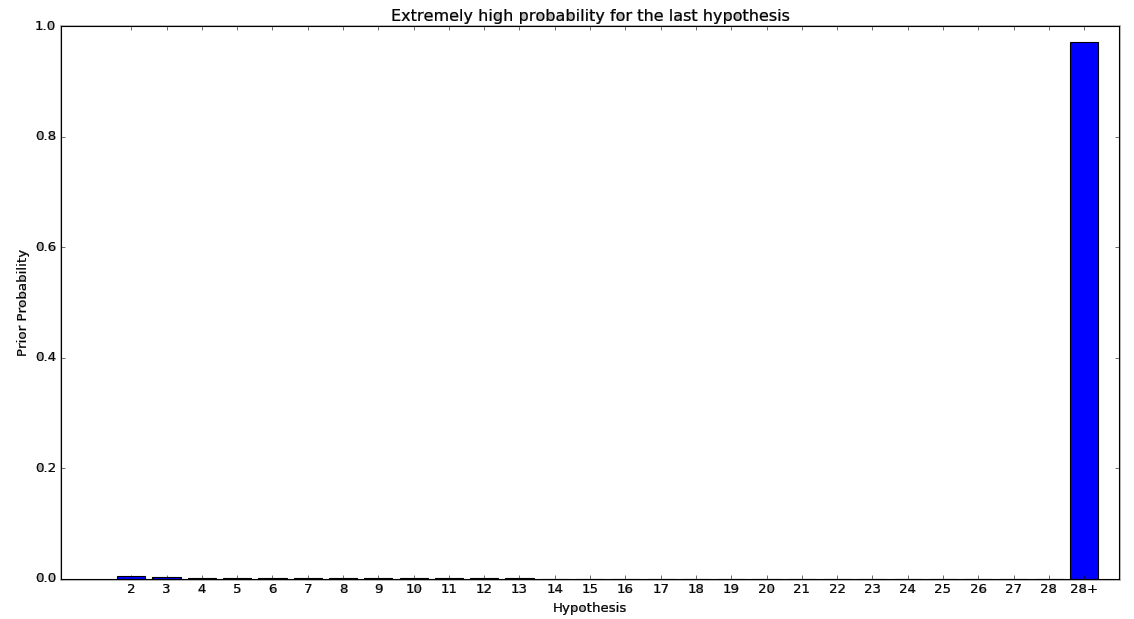
The prior probabilites show half the impact in reporting the posterior. That means, if someone does set a high prior probability for that hypothesis then it looks like the posterior probability will be high. Let's see how the results work themselves out when we set the last hypothesis' probability to 99.5%, leaving the other 0.5% shared by the other 29 hypotheses.
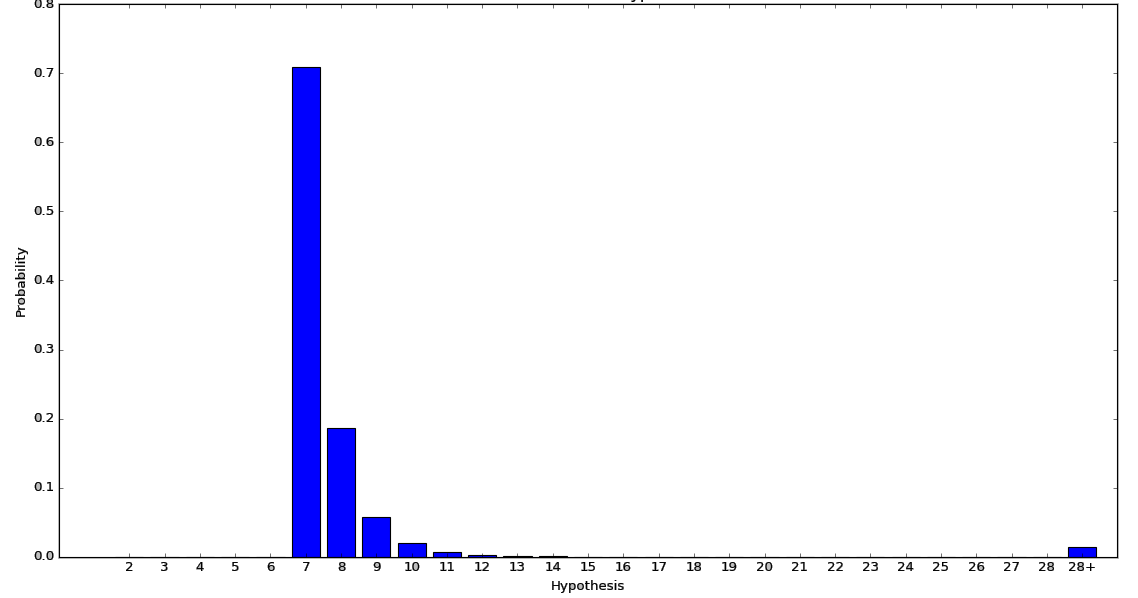
The bottom line is, priorities don't matter if there's enough evidence.